Snus vs Nicotine Pouches: What's Actually Different (and What a UK Buyer Really Gets)
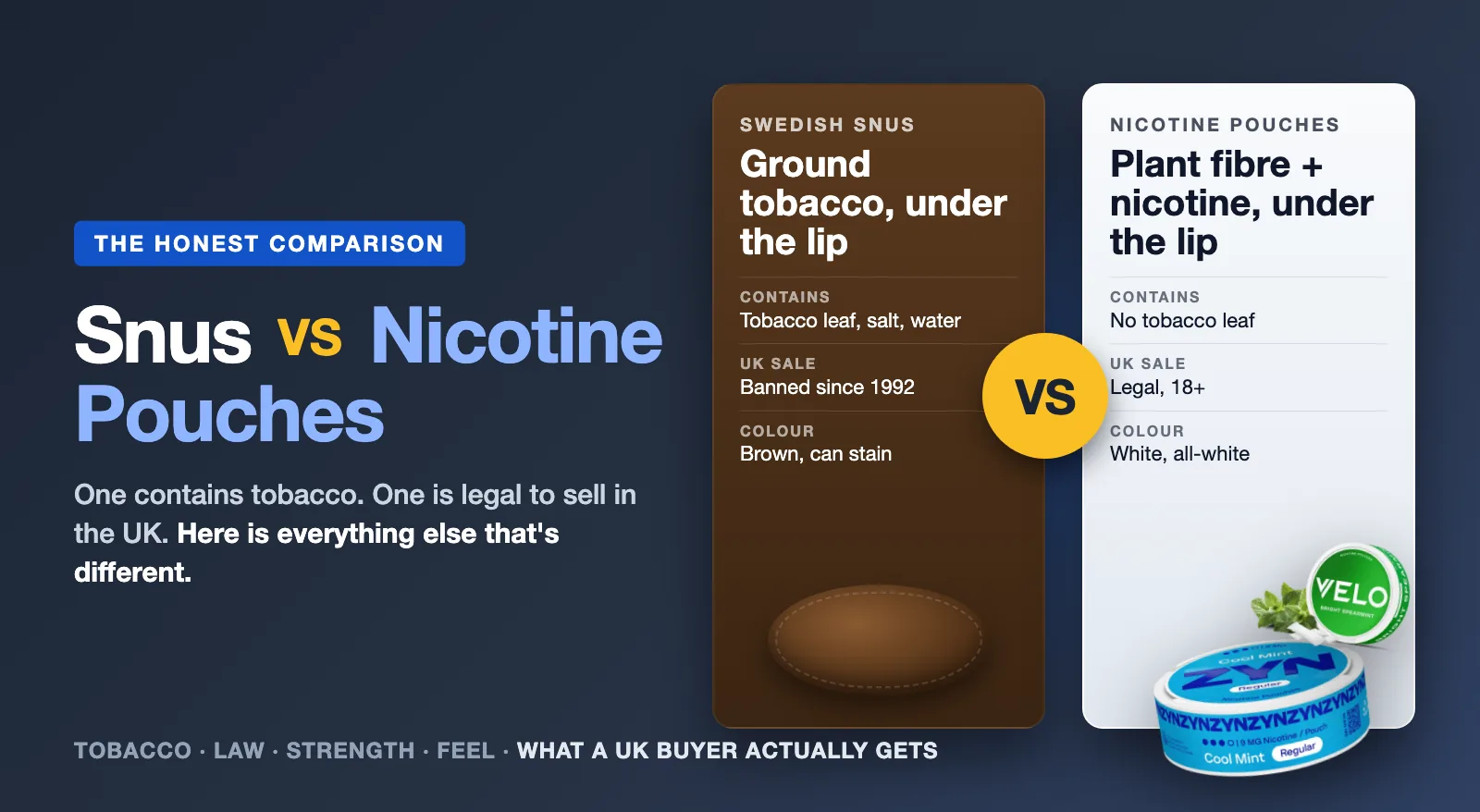
Snus is ground tobacco; a nicotine pouch has no tobacco leaf at all. That one ingredient decides the law, the colour, the health debate and why Britain calls both by the same name. The full comparison, with the studies, the regulations, the mg/g strength trap decoded brand by brand, and which pouch is closest if you used real snus.
The short answer: snus is moist ground tobacco in a little pouch; a nicotine pouch is plant fibre carrying nicotine, with no tobacco leaf in it at all. Both go under the top lip for half an hour or so, neither is spat, and they feel similar enough that Britain uses one word for both. The differences that actually matter are the tobacco (snus has it, pouches don't), the law (snus cannot be sold in the UK, pouches can), the colour (brown stains, white doesn't) and the strength labels, which are written in two different units and trip up almost everyone.
In a hurry? Jump to the comparison table, why one is legal and one isn't, which is stronger, what the research says, or whether ZYN and VELO count as snus.
We get a version of this question most days, and it usually arrives sideways. Someone asks for "the strongest snus", or whether our "snus" will stain their teeth, or whether they can take it to Sweden, and what they are holding is a can of nicotine pouches that has never been near a tobacco leaf. The confusion is not their fault. The products sit in the same spot under the same lip for the same length of time, the cans look alike, and the only "snus" a British shop can legally sell is the kind that isn't.
So here is the whole difference, properly. We sell nicotine pouches for a living and cannot sell tobacco snus at all, which you should weigh when you read this. We have tried to make up for it by linking the actual studies, the actual regulations and, where the research is contested, saying so. One housekeeping note before we start: in this article "snus" means Swedish tobacco snus. When a UK shop says snus, it means pouches. The full story of how that happened is its own article.
Snus vs Nicotine Pouches: The Whole Difference in One Table
| Swedish snus | Nicotine pouches | |
|---|---|---|
| Contains tobacco | Yes, ground tobacco leaf | No leaf. The nicotine is usually extracted from tobacco, then carried on plant fibre |
| Colour | Brown | White, before and after use |
| What's inside | Tobacco, water, salt, sodium carbonate, humectants, flavouring | Cellulose fibre, nicotine salt, fillers, sweetener, pH adjusters, flavouring |
| Moisture | Wet: typically 45 to 60% water | Anywhere from bone dry to 40%, depending on brand and format |
| Legal to sell in the UK | No, since 1 January 1993 | Yes, to adults. 18+ becomes law on 29 October 2026 |
| Strength label | mg per gram (8 mg/g is "normal") | A mess: some brands per pouch, some per gram |
| Nicotine you actually absorb | Around a third of what's in the portion | Over half of what's in the pouch |
| Teeth staining | Yes, over time | No tobacco staining |
| Gum irritation | Very common | Also common. Not the free pass people assume |
| Time under the lip | 30 to 60 minutes | 20 to 60 minutes; most brands say about 30 |
| Spitting | No | No |
| Storage | Fridge; 14 to 30 weeks' shelf life | Drawer; best-before around a year |
| Invented | Sweden, 1800s (Ettan dates from 1822) | Mid-2010s |
If you only remember one row, make it the first. Every other difference, the law, the colour, the health debate, flows from whether there is tobacco in the pouch.
What Snus Actually Is
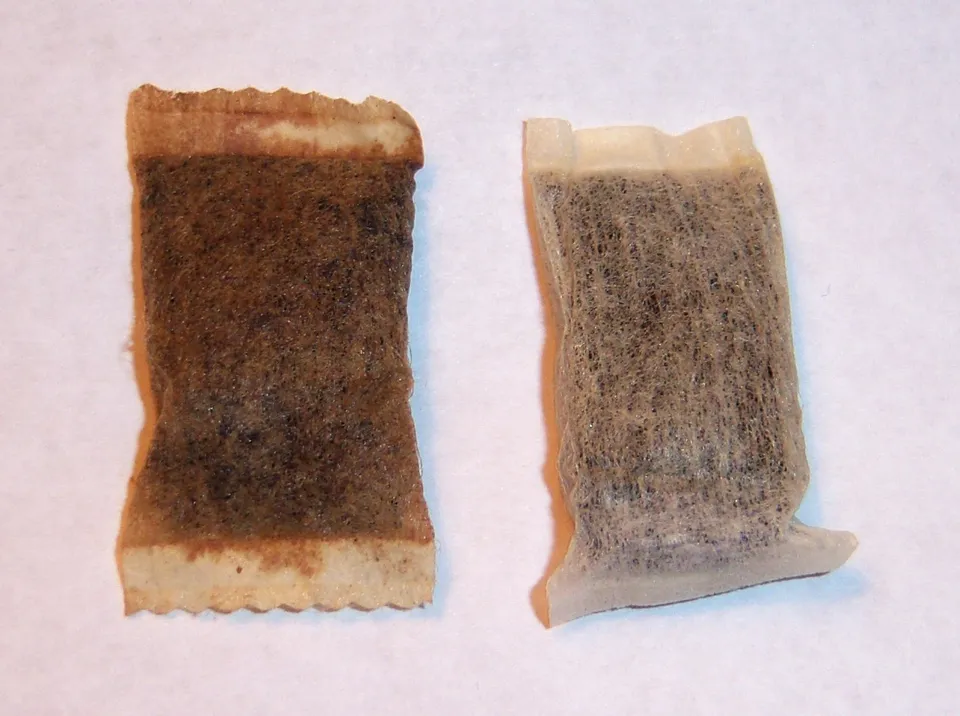
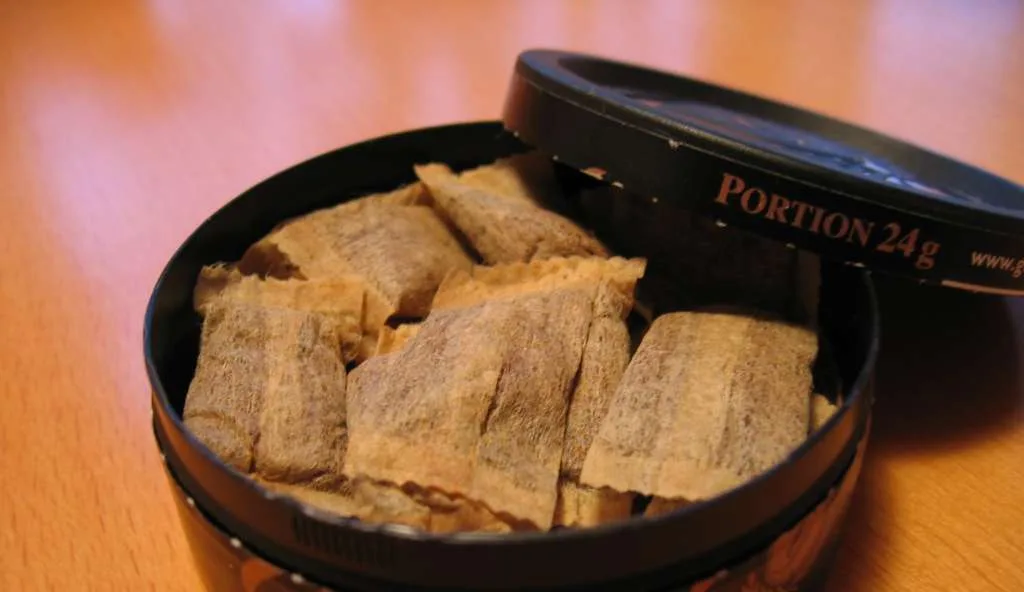
Snus is a Swedish oral tobacco. Finely ground air-cured tobacco is mixed with water, salt and sodium carbonate, then heat-treated with steam at up to 80 to 100°C for several hours. That step is the thing that makes Swedish snus different from American dip: the Americans ferment their tobacco, the Swedes effectively pasteurise it, which kills the bacteria that would otherwise turn nitrate in the leaf into nitrosamines, the main carcinogens in smokeless tobacco. The process was worked out for the Ettan brand in the 1820s and is now written into the industry's own GOTHIATEK standard, which caps the two worst nitrosamines (NNN and NNK) at 0.95 mg per kilo and sets limits for nitrite, heavy metals, benzo(a)pyrene and mycotoxins.
The result is a wet, brown, alkaline product. A US CDC analysis of 56 Nordic snus products found 27 to 60% moisture, a pH around 8 (alkaline, so the nicotine crosses the gum easily), and 7 to 21 mg of nicotine per gram. The sodium carbonate is there for the pH. The salt is a preservative. The flavour is usually tobacco with bergamot, or juniper, or nothing.
It comes in four formats. Loose snus is the original: you pinch it into a lump, or "prilla", with your fingers. Original portions put the same moist tobacco into a small brown pouch. White portions, introduced in the late 1990s, use a drier pouch surface so the release is slower and there is far less drip. Minis are smaller versions of either. The thing to note, because it causes real confusion, is that "white portion" snus still contains tobacco. It is not the same as the "all-white" nicotine pouch, however similar the names sound. The big names are General (1866), Ettan (1822) and Göteborgs Rapé, all now owned by Swedish Match, which Philip Morris bought in 2022; Thunder and Odens in the strong end; Siberia, at around 43 mg/g, as the nuclear option.
What a Nicotine Pouch Actually Is
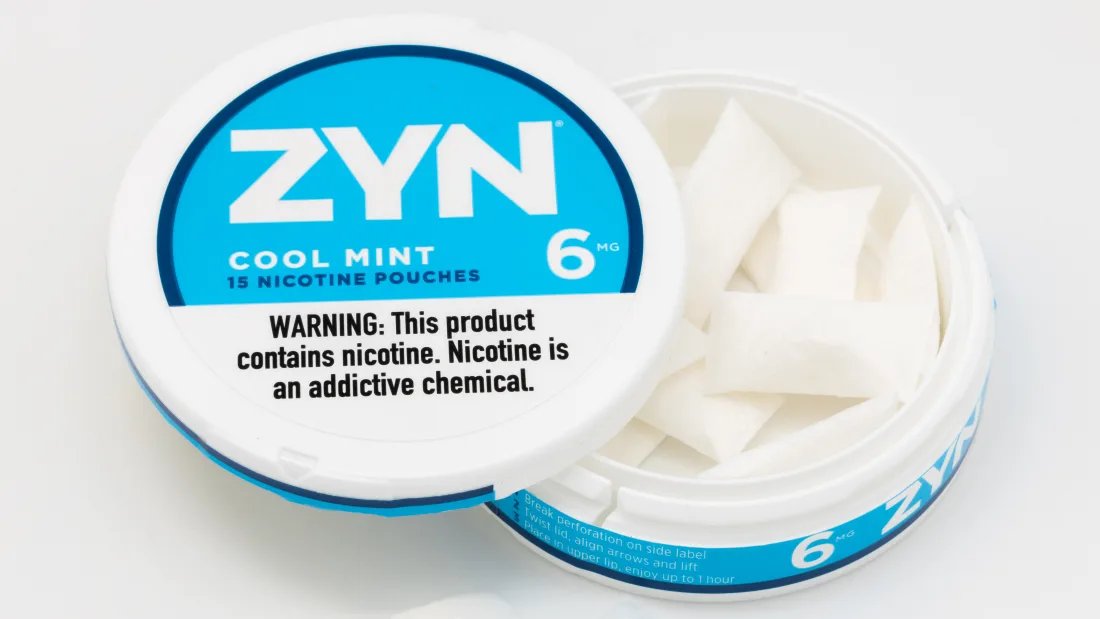
A nicotine pouch takes the snus format and removes the tobacco leaf. Inside the little fleece bag is a filler of plant cellulose (microcrystalline cellulose, or eucalyptus and pine fibre, depending on the brand), nicotine in salt form, sweeteners, pH adjusters like sodium carbonate and bicarbonate, and flavouring. Nothing brown. Nothing that stains. The German federal risk agency's analysis of 44 products from 20 manufacturers found a median pouch weight of 0.64 g, a median pH of 8.8 and nicotine content anywhere from under 2 mg to 47.5 mg per pouch. That last figure is the market's problem in one number, and we will come back to it.
One honest asterisk, borrowed from ZYN's own small print: "tobacco-free" means no tobacco leaf, not no tobacco. The nicotine in almost every pouch on sale in the UK is extracted from tobacco plants and purified to pharmaceutical grade. A few brands use synthetic nicotine; most do not. The product is tobacco-leaf-free, which is what matters for the law and for the toxicology, but it is still a tobacco-derived nicotine product and it is still addictive.
Pouches are newer than people think. The first true all-white products appeared in the mid-2010s (ZYN was test-marketed in the US in 2014 and launched in Sweden in 2016), not the "early 2000s" you will read on some competitor pages. In Britain the big sellers are VELO, Nordic Spirit and ZYN, owned by BAT, JTI and Philip Morris respectively, with Killa, Pablo and Iceberg owning the strong end. They come moist or dry: a regular ZYN is 35 to 40% water and a ZYN Mini is almost bone dry, and that moisture difference changes the feel more than the snus-versus-pouch question does.
Why One Is Legal in the UK and the Other Isn't
The legal test is one ingredient. If a product for oral use contains tobacco in powder or particulate form and is not meant to be smoked or chewed, it cannot be sold in the UK. That is snus. A nicotine pouch contains no tobacco leaf, so the ban does not reach it. Everything else follows from that sentence.
The ban itself is older than most of the people using pouches. The EU outlawed oral tobacco in 1992, in a panic about American smokeless brands being marketed to teenagers. The UK implemented it through the Tobacco for Oral Use (Safety) Regulations 1992, in force from 1 January 1993. Sweden made a permanent exemption a condition of joining the EU in 1995, which is why it remains the one member state where snus is sold legally. The rule was restated in the 2014 Tobacco Products Directive and carried into UK law as regulation 17 of the Tobacco and Related Products Regulations 2016, which reads, in full: "No person may produce or supply tobacco for oral use." Swedish Match challenged it all the way to the EU's top court in 2018 and lost. Brexit changed nothing. We go through all of this, including what happens to snus at the border, in is snus legal in the UK?
Two things are worth being precise about, because the competitor articles are not. First, it is a supply ban, not a possession ban. Owning snus, using it, and bringing a modest amount home from Sweden for yourself are not offences. There is no official personal allowance, though: the Public Health Minister told the Commons committee on the Tobacco and Vapes Bill that Border Force decides "case by case" whether a quantity looks personal or commercial, and a suitcase full is going to be treated as stock. Second, the ban is about to get heavier. The Tobacco and Vapes Act 2026 lifts the snus prohibition out of the 2016 regulations and writes it into primary legislation: from 29 October 2026, sections 7 to 9 make manufacturing snus, selling it, offering it for sale, and possessing it with intent to supply all criminal offences carrying up to two years' imprisonment, and section 92 gives HMRC officers the power to seize it. Any UK website offering "real Swedish snus" for delivery is not in a grey area. It is breaking the law now and will be committing an imprisonable offence from the autumn. Carrying a personal stash home in your own suitcase is a different story, walked through in our guide to snus and pouches on a plane.
Pouches travel the other way. Until this year they were not covered by tobacco law at all: they sat under general consumer product safety rules, with no statutory age limit, no nicotine cap and no advertising restrictions beyond the ASA's. The same Act, which received Royal Assent on 29 April 2026, fixes the first of those from 29 October 2026: selling nicotine pouches to anyone under 18 becomes a criminal offence enforced by Trading Standards, free samples are banned, and vending machine sales end. Advertising and sponsorship restrictions follow once ministers set a date, expected around mid-2027. A government consultation that closes on 2 October 2026 proposes plain white packaging for pouches, single-word flavour names and behind-the-counter display. What the Act does not do, despite what you may have read, is set a maximum nicotine strength. There is a power to do it. As of August 2026 nothing has been proposed, and the packaging consultation says in terms that it does not cover nicotine limits.
For completeness: snus is legal in Sweden, Norway, Switzerland and the United States, where the FDA has authorised eight General snus products to be sold with a modified-risk claim since 2019. Nicotine pouches, meanwhile, are banned outright in Belgium, the Netherlands and France, and capped at 9 mg per pouch in Denmark. Europe has not made its mind up about either product. Britain has, in opposite directions.
Is Snus Stronger Than Nicotine Pouches? The mg/g Trap
This is where almost every comparison on the internet goes wrong, including some published by the brands themselves. Snus strength is quoted in milligrams per gram of tobacco. Nicotine pouch strength is quoted per pouch by some brands and per gram by others, and the two numbers are not comparable without knowing what the pouch weighs. A Swedish "normal" snus is 8 mg/g; strong is 11 to 14; extra strong 16 to 22; Siberia sits around 43. A standard General portion weighs about a gram, so "8 mg/g" and "8 mg in the portion" happen to be nearly the same number. With pouches, which weigh anywhere from 0.4 g to 0.8 g, they are not.
Here is what the cans in our own shop actually mean. We have audited this against pouch weights rather than trusting the lid.
| Brand | How the can is labelled | Pouch weight | Nicotine per pouch |
|---|---|---|---|
| ZYN | Per pouch | 0.4 to 0.5 g | 1.5 to 13.5 mg, as printed |
| VELO | Per pouch | 0.4 g (Mini) to 0.7 g (Slim) | 6 to 17 mg, as printed |
| Nordic Spirit | Per pouch | 0.7 g | 6 to 17 mg, as printed |
| Fumi | Per pouch | 0.7 g | 4 to 15 mg, as printed |
| Killa "16" | Per gram | 0.8 g | About 13 mg |
| Iceberg "20" and "50" | Per gram | Around 0.7 g | About 13 mg and 35 mg |
| Cuba "16", "30", "43" | Per gram | Around 0.7 g | Roughly 11, 21 and 30 mg |
| Pablo "50" | Per gram | 0.6 to 0.7 g | Roughly 30 to 35 mg |
| Swedish snus, "normal" | Per gram (8 mg/g) | About 1 g | About 8 mg |
| Siberia snus | Per gram (43 mg/g) | About 1 g | About 40 mg |
So the honest answer to "is snus stronger?" is: the strongest pouches sold in Britain are stronger than almost all snus, and ordinary pouches are in the same range as ordinary snus. A Pablo 50 carries more nicotine than any General product ever made. A ZYN 6 is a shade under a normal snus. If you want a tidy illustration of why mg/g is a useless number on its own, Norway provides one: between 2005 and 2020 the average nicotine concentration of snus sold there rose from 16 to 24 mg/g while the nicotine per portion stayed flat at about 13 mg, because the portions got lighter as tobacco tax went up. Same dose, bigger number on the tin.
Delivery matters too, and here pouches have an edge snus users do not expect. In the one head-to-head pharmacokinetic study, Lunell and colleagues (funded by Swedish Match, so read accordingly) found that users extracted 56 to 59% of the nicotine from a ZYN pouch over an hour but only 32% from a General snus portion and 19% from American dip. A 6 mg ZYN actually delivered more nicotine than an 8 mg General. Blood levels peaked at about the same time for both, an hour or so in. Compare that with a cigarette, which peaks in five to eight minutes: an independent Ottawa meta-analysis of seven trials found pouches peak at 20 to 65 minutes, and that an 8 mg or stronger pouch exposes you to more total nicotine than a cigarette does. Slower on, slower off, and not weak. Our strength guide has the per-brand ladders if you want to pick a number.
How They Feel to Use
Mechanically they are the same product: tuck it under the top lip, off to one side, leave it, throw it in the catch lid. If you can use one you can use the other, and our how-to guide covers the technique for both. The differences are texture, taste, drip and time.
Drip. Original snus is wet, heavy and sits like a warm lozenge; for the first ten minutes it gives off a fair amount of tobacco-flavoured saliva, which you swallow. White portion snus was invented in 1997 specifically to fix that. Pouches are drier and slimmer and drip much less, but the gap between a moist VELO and a dry ZYN Mini is at least as big as the gap between white snus and a pouch. People who say pouches "don't drip" have not tried a moist 0.8 g Killa.
Spitting. Neither snus nor pouches are spat. That is American dipping tobacco, which is fermented, acidic and wet enough to need it. Competitor articles that talk about pouches saving you from "bitter tobacco juice you need to spit" have confused snus with something from a baseball dugout. You swallow normally with both.
Taste. Snus tastes of tobacco: earthy, salty, often with bergamot or juniper over the top. Most of the pouch market tastes of mint, fruit, coffee or sweets, because there is no leaf to flavour. If you are coming from snus and want something in the same register, the coffee and spicy and herbal shelves get closest. We do not stock a tobacco-flavoured pouch, and there are not many good ones.
Time. Swedish snus users typically leave a portion in for 30 to 60 minutes. Brand guidance for pouches clusters around half an hour: ZYN and VELO say about 30 minutes and up to 60; Nordic Spirit tells first-timers to start at 15 and work up to 30, and to bin it after an hour. The flavour runs out before the nicotine does with both.
Storage. Snus lives in the fridge. Swedish Match quotes a shelf life of 14 weeks for loose, 20 for portions and 30 for dry formats when chilled, and up to a year frozen. Pouches are a drawer product with a best-before date roughly a year out. They do not need refrigerating, and nothing bad happens to them at room temperature except slow fading.
Health: What the Evidence Actually Says About Each
Both products deliver a drug. Neither is harmless. The honest comparison is between two kinds of uncertainty: snus has decades of Swedish data showing modest, specific harms; pouches have almost no long-term data at all, and a short-term toxicant profile that looks a good deal cleaner. Here is each in turn, with the studies.
Snus
The IARC classifies all smokeless tobacco as a Group 1 carcinogen, and the nitrosamines NNN and NNK, which are present in snus, individually as well. The pasteurisation matters enormously to how much: that CDC analysis found Nordic snus averaging about 836 nanograms of NNN plus NNK per gram, against 3,000 to 50,000 in American moist and dry snuff. Low for tobacco is still not zero.
On cancer, the Swedish cohort data genuinely disagree with each other, and anyone who tells you it is settled is selling something. A 2007 Lancet study of 280,000 construction workers found never-smoking snus users had double the rate of pancreatic cancer; a 2017 pooled analysis of nine Swedish cohorts, 424,000 men, found no association at all once smoking was properly accounted for. Oral cancer, the one everyone assumes, shows no excess in the Scandinavian data. The most recent systematic review, by the Norwegian Institute of Public Health in 2023, reported raised risks for oesophageal, pancreatic, stomach and rectal cancer but graded the confidence in all of them as moderate to very low. On the heart, the picture is steadier: snus does not seem to raise your chance of a heart attack or stroke, but Swedish data consistently show worse odds of surviving one, and heart-attack patients who quit snus halved their mortality compared with those who carried on, a benefit the authors called similar to quitting smoking. A 2021 pooled study of 169,000 never-smokers found snus users' all-cause mortality 28% higher, rising with years of use. Gum-wise, nearly every snus user develops a lesion at the placement site, which reverses within a fortnight of stopping; the gum recession it causes over years does not.
Against all that sits the FDA's 2019 decision to let General snus carry the claim that using it instead of cigarettes "puts you at a lower risk of mouth cancer, heart disease, lung cancer, stroke, emphysema, and chronic bronchitis". Note the wording: lower than smoking. Not safe.
Nicotine pouches
Take the tobacco out and most of the tobacco-specific toxicants go with it. The German risk agency's study found nitrosamines in 26 of its 44 pouches, but at a maximum of 13 nanograms per pouch, against roughly 800 in a gram of the cleanest snus. A BAT-funded comparison of 24 compounds could not detect 22 of them in pouches (or in nicotine gum and lozenges) versus 11 in snus, and concluded that on toxicants pouches belong next to NRT. An independent 2025 review reached much the same place: lower than snus on nitrosamines, cadmium, arsenic and lead; similar on formaldehyde; higher than NRT on both. In June 2026 the FDA went a step further than any regulator had for a pouch and authorised twenty ZYN products to carry the same lower-risk-than-cigarettes claim as General snus.
The catch is the nicotine itself, and the strengths the market has drifted to. The UK's Committee on Toxicity has said pouches deliver "a pharmacologically active dose of nicotine" and "are not harmless". An independent German trial found a 30 mg pouch pushed blood nicotine almost twice as high as a cigarette, raised heart rate by 25 beats a minute and stiffened the arteries, and its authors called for a legal strength cap. Then there are your gums. A Karolinska study published this year compared 272 young adults and found mouth lesions in 79% of pouch users against 89% of snus users, and gum recession at the placement site in 44% of pouch users against 52% for snus and none in non-users. Pouches will not stain your teeth brown. They are not, on current evidence, kinder to your gums in any way that should change your decision, and mint flavours trended worst. Rotate the spot. Do not park it in the same place all day.
The bottom line, from a shop that sells one of these: if you already use snus or smoke, a pouch is very probably the lower-toxicant option, and the FDA now says as much in writing. If you use neither, the toxicology is irrelevant, because the dominant risk is the addiction and there is no version of either product that avoids it.
Sweden: The Experiment Nobody Else Ran
Sweden is the only country that kept snus legal for thirty years while the rest of Europe banned it, so it is the closest thing to a natural experiment we have. The numbers are striking. The Public Health Agency of Sweden put daily smoking at 5.4% of adults in 2024, and the 2025 national survey published this spring reports it has dropped below 5%, the threshold the WHO treats as "smoke-free", with figures between 3.7% and 4.8% depending on the age range used. The EU average is over four times that. Meanwhile 22% of Swedish men use snus every day, and daily nicotine pouch use has reached 5% of adults and 15% of young women. Swedish men have the lowest lung cancer incidence in the EU: 39 cases per 100,000, against an EU average of 95.
How much of that is snus is the contested part. Sweden also has high tobacco taxes, strong public health campaigns and a long-standing cultural preference for snus over cigarettes that predates any policy. The sensible reading is that snus is part of why Swedes stopped smoking, not the whole reason, and that nicotine has not gone anywhere: it has moved from the lungs to the lip. Which, if you are choosing between the two, is still the point.
Is ZYN Snus? Is VELO? Brand by Brand
No British brand is snus. Every one of them is a tobacco-leaf-free nicotine pouch, because that is the only kind a UK shop can sell. But the question gets asked brand by brand, so here it is brand by brand.
- ZYN: not snus. Made by Swedish Match, which also makes General snus, which is where the confusion starts. Dry-ish, slim, labelled per pouch, 1.5 to 13.5 mg in the UK. Is ZYN snus? gets the full treatment.
- VELO: not snus. BAT's pouch, moist slim format, 6 to 17 mg per pouch. The "Is VELO the same as snus?" question is common enough that VELO has a blog post about it, which at least gets the 1992 regulations right.
- Nordic Spirit: not snus. JTI, made in Sweden, which is why its name and branding lean Scandinavian. 6 to 17 mg per pouch.
- Killa: not snus, although "Killa snus" is what half the country searches for. Labelled 16 mg/g; about 13 mg in its 0.8 g pouch. Made by NGP Empire in Denmark, not Sweden.
- Pablo: not snus. The "50" on the lid is per gram; the pouch carries roughly 30 to 35 mg, which is still more than any mainstream Swedish snus. Same Danish maker as Killa.
- Iceberg and Cuba: not snus. Both label per gram (Iceberg 20 and 50, Cuba 16, 30 and 43) and both sit at the strong end. Both are made in Poland, a long way from Gothenburg.
If it is white and on sale in Britain, it is a pouch. Our ranking of every "snus" brand we stock compares them properly.
Used Real Snus Before? Which Pouch Is Closest
A fair number of our customers are Swedes, Norwegians, or Brits who got a taste for snus on a stag weekend in Stockholm and came home to find it unbuyable. For them the question is not "what's the difference" but "what's the nearest thing". Roughly:
| If you used | That's about | Closest UK pouch strength | Examples |
|---|---|---|---|
| Normal snus (8 mg/g) | 8 mg a portion, of which you absorb a third | 6 to 9 mg per pouch | ZYN 6, VELO 6 or 10, Nordic Spirit 6 or 9 |
| Strong (11 to 14 mg/g) | 11 to 14 mg a portion | 10 to 14 mg per pouch | VELO 10 or 14, ZYN 11, Nordic Spirit 11, Killa |
| Extra strong (16 to 22 mg/g) | 16 to 22 mg a portion | 14 to 20 mg per pouch | VELO 17, Nordic Spirit 17, Iceberg 20 mg/g, Cuba 30 mg/g |
| Siberia and friends (43 mg/g) | About 40 mg a portion | 30 mg and up | Pablo 50 mg/g, Iceberg 50 mg/g, Cuba 43 mg/g |
Two adjustments. Because you absorb a larger share of the nicotine from a pouch, most snus users should step down one rung from their snus number, not match it: a 14 mg/g snus habit is a 10 to 11 mg pouch, not a 14. And choose a moist format if you miss the feel of an original portion: Killa, Pablo, VELO Slim and Nordic Spirit are all wetter than ZYN. The full range, sorted by strength, lives on the snus collection, which, yes, contains no snus. We have explained why.
Snus vs Nicotine Pouches: Your Questions, Answered
Are snus and nicotine pouches the same thing?
No. Snus is ground tobacco in a pouch; a nicotine pouch has no tobacco leaf in it, just nicotine on plant fibre. They are used identically, under the top lip for around half an hour, which is why British shops and customers use one word for both. Legally, chemically and in colour they are different products.
Is snus stronger than nicotine pouches?
Not as a rule. Ordinary snus is 8 mg/g, about 8 mg in a gram-sized portion, which lands in the middle of the pouch range. The strongest pouches on sale in Britain (Pablo, Iceberg and Cuba at 43 to 50 mg/g, roughly 30 to 35 mg per pouch, and Maggie’s 60 mg/g Original at roughly 45 mg) are stronger than almost all snus. And you absorb a bigger share of the nicotine from a pouch, so like-for-like numbers are not like-for-like doses.
Why is snus illegal in the UK?
The EU banned oral tobacco in 1992 over fears about smokeless tobacco being marketed to teenagers, and the UK implemented the ban from 1 January 1993. It survived Brexit as regulation 17 of the 2016 tobacco regulations and from 29 October 2026 it sits in the Tobacco and Vapes Act itself, with up to two years' imprisonment for selling it. Sweden negotiated an exemption when it joined the EU; nobody else did.
Is it illegal to have snus in the UK?
No. The ban is on producing, selling and possessing with intent to supply. Using snus and owning a modest amount for yourself are not offences, and bringing some home from Sweden is tolerated, though Border Force judges quantity case by case and there is no official allowance. Buying it from a UK website is a different matter: the seller is breaking the law.
Is one snus equivalent to one cigarette?
In total nicotine, a normal snus portion or a 6 to 8 mg pouch delivers roughly what a cigarette does, just over 30 to 60 minutes instead of five. What you do not get is the hit: a cigarette peaks in the blood in five to eight minutes, a pouch or snus in half an hour or more. That slower curve is why people switching from smoking often find pouches "do nothing" for the first week.
Is 20 nicotine pouches a day a lot?
Yes. Most regular users settle between five and ten a day, and NHS cessation guidance works on a ceiling of about one an hour. Twenty pouches of a mid-strength product is a heavy habit by any standard; twenty Pablos is several hundred milligrams of nicotine. Our guide to how many pouches a day goes through the numbers.
Is ZYN snus?
No. ZYN is a tobacco-leaf-free nicotine pouch made by Swedish Match, the company that also makes General snus. The shared parent is the whole reason for the confusion. ZYN's nicotine is extracted from tobacco, which is why its own packaging says "tobacco-free" with an asterisk.
Is VELO the same as snus?
No. VELO is BAT's nicotine pouch: white, tobacco-leaf-free and legal to sell in the UK. You will see "VELO snus" written everywhere, including on shop shelves, but it is shorthand, not a description.
Do you spit with snus or nicotine pouches?
Neither. Spitting belongs to American dipping tobacco. Swedish snus is pasteurised and alkaline and is designed to be swallowed around; so are pouches. Original snus portions produce more saliva early on than a dry pouch does, but you swallow it with both.
Which is worse for your teeth and gums?
For staining, snus: it is brown tobacco and it marks enamel over time, whereas white pouches do not. For gums, the gap is smaller than people assume. A 2026 Karolinska study found gum recession at the placement site in 44% of pouch users and 52% of snus users, and mouth lesions in 79% and 89% respectively. Rotate where you put it with either product.
Keep Reading
- What is snus?: the history, the formats and how Britain ended up calling pouches by its name.
- Is snus legal in the UK?: the 1992 ban, the border, and the 2026 Act in plain English.
- Is ZYN snus?: the most-confused brand, answered flavour by flavour.
- How to use nicotine pouches (and snus): placement, timing and the spit question.
- Snus and football: why one in five professional players uses it, and what they are actually using.
18+ only. Nicotine is addictive. Studies funded by tobacco companies are flagged as such above; where independent and industry research disagree, we have said so. This article describes UK law as of August 2026 and will be updated when the Tobacco and Vapes Act provisions commence.