Snus and Football: Why So Many Players Use It (and What It Actually Does)
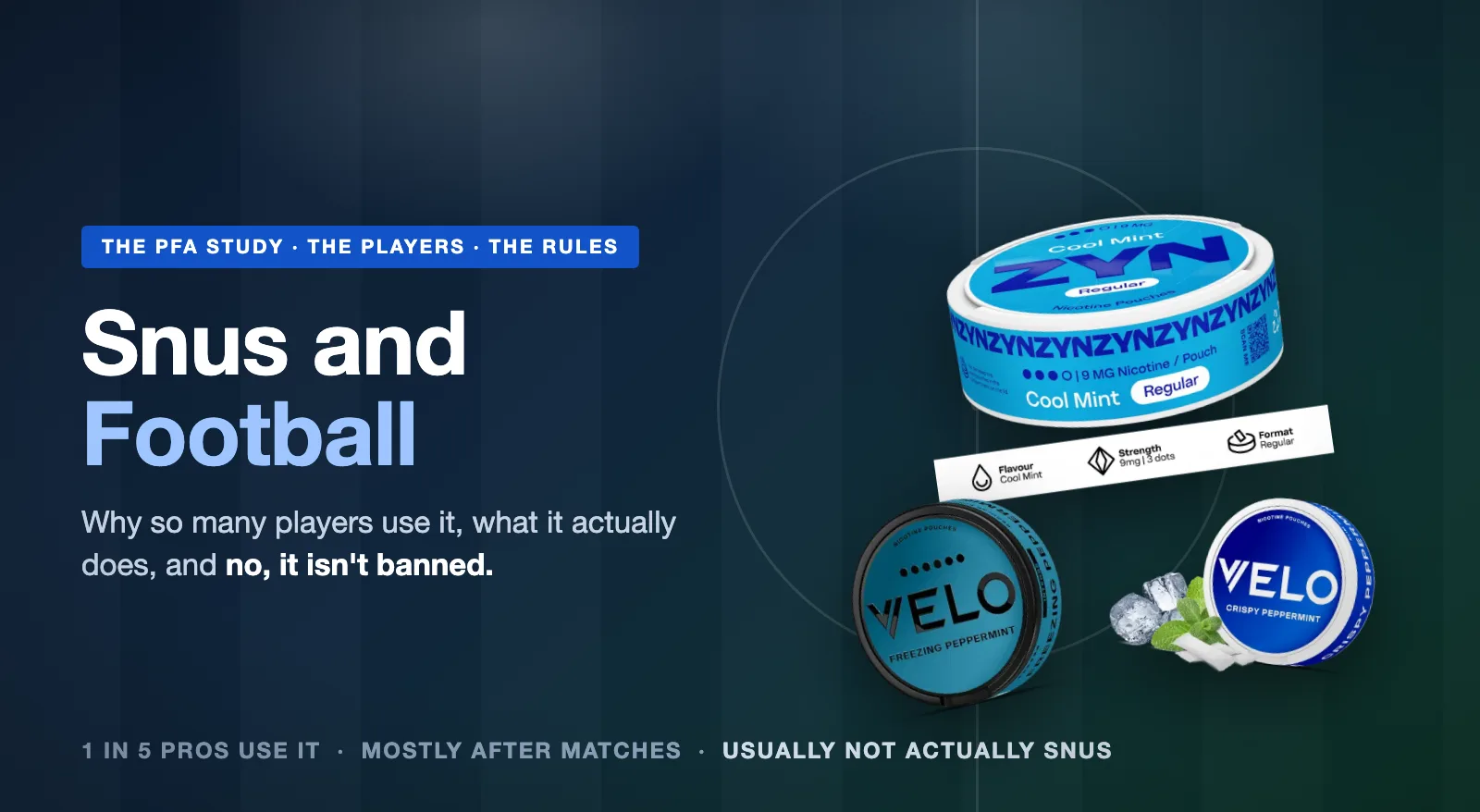
Roughly one in five professional footballers uses snus or nicotine pouches, and the reason is not the one the headlines assume. The PFA study numbers, the players photographed with tins, what the rules actually say, and an honest answer on whether it does anything for performance.
The short answer: roughly one in five professional footballers currently uses snus or nicotine pouches, and the biggest study we have says they mostly do it to relax after training and matches, not to play better. It is not banned by WADA, the FA or the Premier League. And in most cases it is not actually snus at all: what players call "snus" is usually a legal, tobacco-free nicotine pouch.
In a hurry? Jump to the real numbers, the players who've been linked to it, whether it's banned, or whether it actually does anything for performance.
Every summer tournament it happens again. A dressing-room photo goes round, someone zooms in on a little round tin on the shelf, and by the evening our shop inbox has a fresh batch of the same question: is that snus, and why does half the squad seem to use it? At the 2026 World Cup it was a peppermint tin in Michael Olise's locker. Before that it was Jamie Vardy's tub at Euro 2016. The faces change. The tin does not.
We sell nicotine pouches for a living, so we watch these stories with a slightly different eye to the tabloids. Most of the coverage gets the basics wrong: what the product actually is, what the rules actually say, and what the research actually found. The real story is better than the headlines, and in places quite a bit darker. Here is all of it, properly sourced, from a UK shop that knows the difference between a snus tin and a pouch can at twenty paces.
First Things First: It Usually Isn't Snus at All
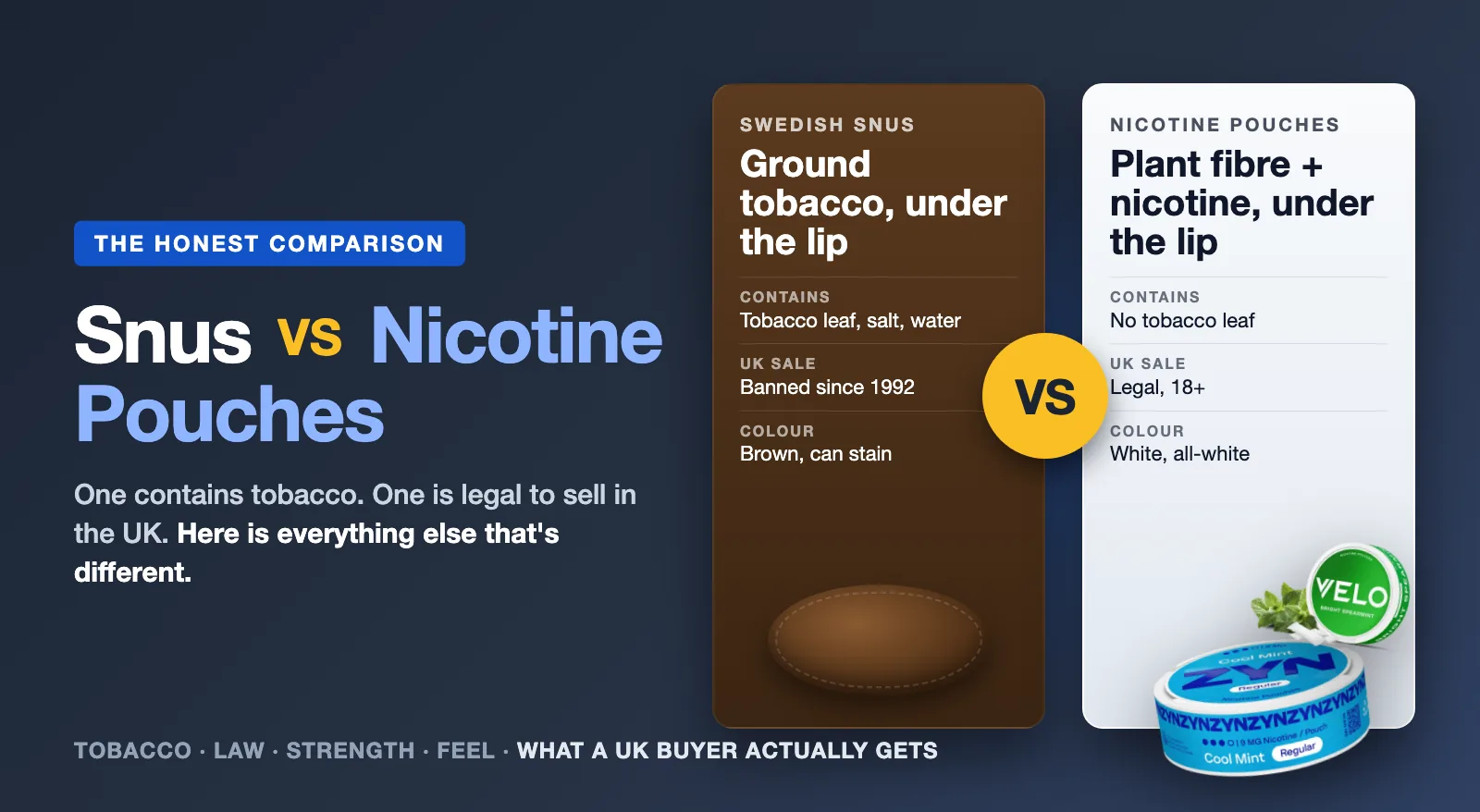
The word "snus" gets used for two different products, and the difference matters more in football than almost anywhere else. We compare them line by line in snus vs nicotine pouches; the short version follows.
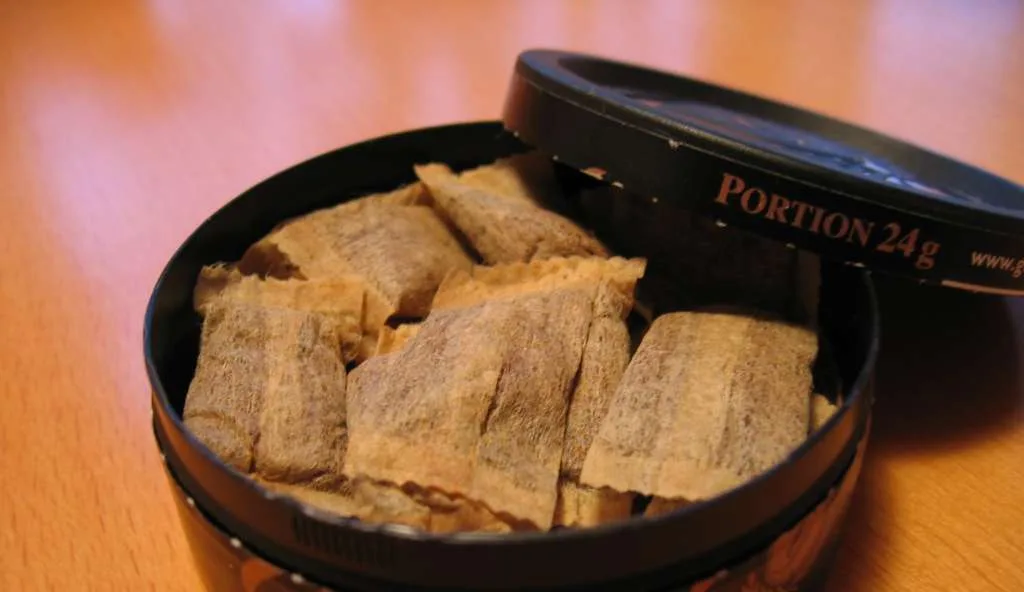
Real snus is Swedish: moist ground tobacco in a small pouch, tucked under the lip. Selling it has been illegal in the UK since 1992, when the EU banned oral tobacco everywhere except Sweden, a rule Britain kept after Brexit. Using it is not a crime, but no UK shop can legally put it on a shelf. We wrote the whole legal picture up in our guide to whether snus is legal in the UK.
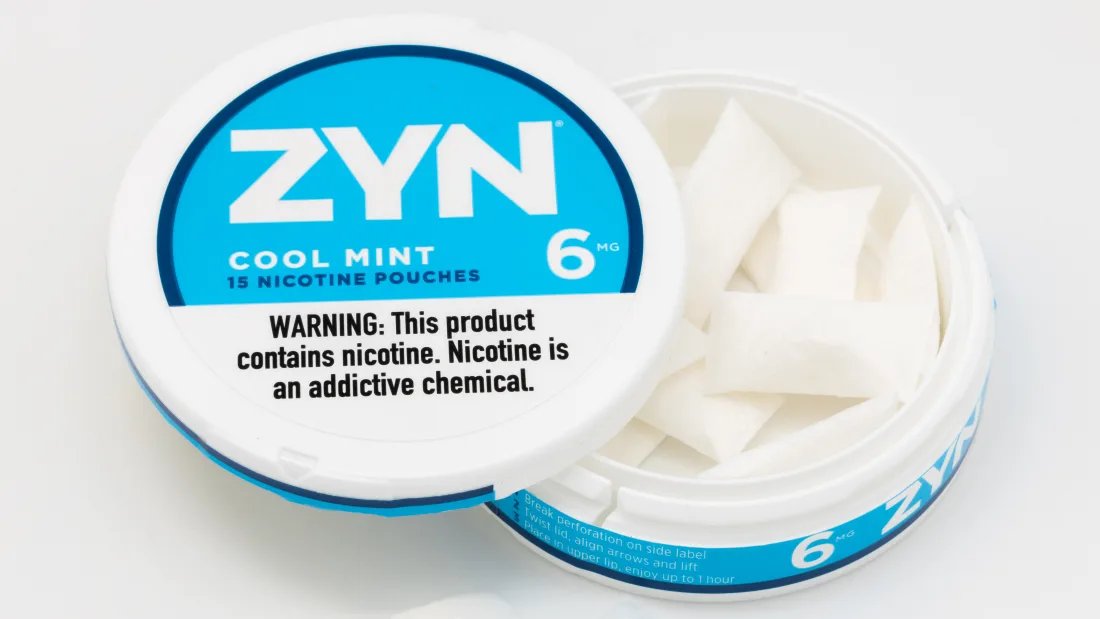
What footballers in England are mostly using is the modern descendant: the tobacco-free nicotine pouch. Same shape, same under-the-lip habit, but white, dry, and containing no tobacco leaf at all, which is why it is perfectly legal to sell here. The researchers behind the biggest study on this were unusually blunt about the confusion: players say "snus", but most of what they actually buy is the legal pouch from a shop. Sixty-two per cent of the male players who use it told the study they get theirs from ordinary retail, not from some grey import channel.
So when a pundit says "snus is sweeping football", read it as "nicotine pouches are sweeping football, and everyone is using the wrong word". If you want the full family tree, from 18th-century Swedish tobacco tins to the white pouches in our fridge-adjacent display, that lives in our what is snus explainer.
How Many Footballers Use It? The Real Numbers
For years this was all anecdote. Then in May 2024 the Professional Footballers' Association commissioned Loughborough University to actually count, surveying 628 male players across the Premier League and EFL plus 51 players from the WSL, alongside interviews with club performance and medical staff. It remains the only serious dataset in the world on this, and the published findings are startling.
| What the PFA study found | Men | Women (WSL) |
|---|---|---|
| Currently use snus or nicotine pouches | 18% | 22% |
| Have used at least once | 42% | 39% |
| First used it to relax | 41% | 64% |
| Use after training | 86% | 73% |
| Showed at least one sign of nicotine dependence | 53% | 73% |
| Had received no education about it | 58% | 86% |
Two details make those percentages heavier than they look. First, the researchers themselves say the true figure is probably higher, because admitting nicotine use to a survey, even an anonymous one, is not something every professional athlete rushes to do. One club staffer interviewed for the study put usage in his own squad at 65 to 70 per cent. Second, the general population comparison: ASH's 2026 figures put current pouch use at 1.4% of UK adults and 3% of 18 to 34 year olds. Professional footballers are using at roughly six times the rate of other young adults. Whatever is going on in football, it is not a coincidence.
Why Do Footballers Use Snus?
Not for the reason most people assume. The lazy answer is "performance", and the study data flatly disagrees. Look at when players actually use it: 86% after training, 85% after matches, 72% on days off. Only about one player in ten reported using during a game. That is not the usage pattern of a performance drug. It is the usage pattern of a wind-down ritual.
The most common first reason players gave for starting was relaxation, 41% of men and 64% of women, and "a relaxing sensation" was the most-reported effect of use. Dr Daniel Read, who led the research, summed it up: use among professional footballers is far higher than in the general population, and players are reaching for these products "to relax and manage stress". The PFA's wellbeing director Michael Bennett called it what it is: a coping mechanism for the growing demands of the game.
Three other threads run through the interviews. There is the social one: younger players copy senior pros, and the study found more than half of users started partly to fit in with older teammates. There is the boredom-and-pressure one: hotel nights before away games, endless travel, a career where one bad month is public property. And there is a surprisingly practical one: unlike a cigarette or a vape, a pouch is invisible, odourless and needs no fire alarm disabled. Danny Murphy, who has admitted using during his own career, put it plainly on talkSPORT: it was simply more socially acceptable in a dressing room than sitting there "smoking a fag".
One myth the data kills outright: this is not smokers switching. Ninety-five per cent of the male players using pouches said they were not using them as a smoking substitute. Football's pouch habit grew on its own, out of Scandinavian dressing-room culture, not out of a quit-smoking campaign.
Which Footballers Have Been Linked to Snus?
A long and fairly star-studded list, though it is worth being precise about what "linked" means in each case. Some players have openly admitted it. Some were photographed and said nothing. Here are the documented cases, not the message-board ones.
| Player | Year | What actually happened |
|---|---|---|
| Henrik Larsson | 1990s | The original. Swedish legend and long-time open snus user from a country where it is legal and everywhere |
| Jamie Vardy | 2016 | Wrote in his autobiography that a teammate introduced him when he signed for Leicester and it "helped me chill out". Photographed with a tub at England's Euro 2016 base; said team staff had no problem with it. Says he later stopped |
| Victor Lindelöf | 2017 on | Has spoken openly about snus, having grown up with Sweden's snus culture |
| Kieran Trippier | 2023 | Fans spotted what looked like a pouch under his lip during a Newcastle interview. He never commented |
| Dele Alli | 2023 | Photographed with a tin of strong Swedish snus, in the same period he later spoke bravely about his wider struggles |
| Marcus Rashford | 2025 | Photographed on holiday in Saint-Tropez holding a pouch tin |
| Michael Olise | 2026 | A World Cup locker-room photo appeared to show a VELO peppermint tin on his shelf. Nothing confirmed, no rule broken, no action taken |
The pundits have been franker than the players. Danny Murphy admitted trying it and now argues clubs should ban it. Charlie Adam told BBC Radio 5 Live it was "rife" across the divisions. And the bleakest quote in the whole subject belongs to Lee Johnson, then Sunderland manager, in 2021: he described players "so addicted that they are in hospital with something else and are begging the doctors and nurses to get them a tub". That quote does more explaining than any statistic.
Worth noting what is missing from that table: any player punished. Which brings us to the rules.
Is Snus Banned in Football?
No. Not by WADA, not by FIFA, not by the FA, not by the Premier League. This surprises people, so here is the actual position rather than the assumed one.
Nicotine sits on the WADA Monitoring Program, where it has been since 2012, and it is still there on the 2026 edition. The monitoring list is WADA's watchlist, not its banned list: laboratories track how widely a substance shows up in samples, in case a pattern of abuse ever justifies prohibiting it. Caffeine lives on the same list. So a player can use a pouch the night before a match, get tested the next day, and face no consequence whatsoever. The Italian anti-doping lab data shows how routine it is: across 2012 to 2020, nicotine turned up in about 29% of footballers' samples.
The FA has no rule against it. The Premier League has no policy on it. When the Olise photo went round the world in June 2026, FIFA did precisely nothing, because there was nothing to do. The only rules that exist are private, club-level ones: a 2018 Daily Mail investigation reported one club privately fining a player £10,000 and another docking two weeks' wages for snus found in a kit bag, and Pep Guardiola's Manchester City brought in doctors to educate players rather than punish them.
Interestingly, the PFA study came down firmly against bans. Staff interviewed said club bans simply drove the habit underground, with players covering for each other, and the researchers recommended education and support instead. Even Murphy's "ban it" line is a minority position among the people who have actually studied the problem.
One genuine anti-doping risk does exist, and it is not the nicotine. The study warns that pouches bought from random websites and social media sellers can be counterfeit or contaminated, and a contaminated product is exactly how an athlete ends up with a positive test for something that was never on the label. It is a good argument for buying from a proper retailer, and frankly it applies to the rest of us too.
Does It Actually Improve Performance? Honestly, No
You may have seen a claim floating around that a WADA-funded study found snus improves performance by 13%. We sell nicotine pouches, so a performance benefit would be lovely for us. It is not really there, and that 13% number is a mangled retelling of a single small trial about time to exhaustion, not football performance. Here is what the research actually shows.
| The claim | What the evidence says |
|---|---|
| "It makes you fitter, faster, stronger" | No. A 2017 Sports Medicine review concluded cardiovascular or strength enhancement from nicotine is unlikely. Nobody serious disputes this |
| "It sharpens focus and reaction time" | Small effects on attention and fine motor control show up in lab studies, mostly in non-athletes. Nothing has demonstrated it in elite football |
| "Snus specifically boosts output" | Of ten snus-and-exercise studies, seven found no change, two found a small benefit, one found performance got worse |
| "At worst it does nothing" | Not quite. Nicotine measurably disrupts sleep, and sleep is the foundation of recovery. Staff in the PFA study reported exactly that in their players |
The honest summary: as a performance aid, nicotine is somewhere between nothing and slightly negative for an athlete, once the sleep cost is counted. The study interviews even include a club doctor puzzling over a player's unexplained racing heart, which resolved once the previous night's snus came to light. Players themselves seem to know this. Asked about benefits, most reported none at all, and the most common answer among those who did was "mental readiness", which is a polite way of describing the feeling of a stimulant arriving, not a measured improvement in anything.
If the pros' habit tells you anything useful as a punter, it is about the relaxing ritual, not the football. A pouch will not fix your first touch. We can say that with total confidence, having watched our own Sunday league for years.
The Part Nobody Puts on a Poster
Here is the section the football coverage tends to skip, and the one we would want to read if our kid were in an academy.
Over half of the male players who use showed at least one sign of nicotine dependence. Among the women it was almost three quarters. Six in ten male users reported withdrawal symptoms between pouches: cravings, irritability, restlessness, anxiety. More than half of male users told the study they wanted to quit within the year. And the majority of players, 58% of men and a remarkable 86% of women, said nobody had ever educated them about any of this. Read those numbers together and the picture is not "casual habit". For a meaningful slice of professional football, it is an addiction they walked into blind, in an environment where the product is everywhere and admitting a problem feels career-adjacent.
On the health side, it matters enormously which product we are talking about. Traditional tobacco snus carries documented risks: oesophageal and pancreatic cancer, cardiovascular disease, mouth lesions. Tobacco-free pouches are a much newer product with no long-term evidence yet; the toxicant profile looks substantially lower, but "lower than tobacco" and "harmless" are different sentences, and nicotine itself remains genuinely addictive whatever the delivery method. Gums also take real, local punishment from any pouch parked in the same spot all day, which is why our how to use nicotine pouches guide bangs on about rotating placement and capping how many you use. Our pouches per day guide exists for the same reason.
The PFA now runs confidential support for players who want out, and the study's main recommendation was more education, earlier, especially in academies. Hard to argue with any of that.
What Changes in 2026: The Law Finally Catches Up
Everything above happened during a strange legal window. Until this year, nicotine pouches sat in a genuine loophole in UK law: no statutory age limit, no strength cap, nothing. Any responsible retailer, us included, imposed 18+ rules on ourselves, but the law itself was silent, which is part of how pouches spread so easily through academy-age dressing rooms.
The Tobacco and Vapes Act 2026, which received Royal Assent in April 2026, closes it. From 29 October 2026 selling nicotine pouches to under-18s becomes illegal across the UK, along with free samples, and from mid-2027 pouch advertising and sponsorship goes too. For our customers nothing changes, because we have been checking ID since the day we opened. For football, the interesting clause is the sponsorship one: the era of nicotine brands even flirting with sport marketing is ending before it began.
Curious After Watching the Pros? Read This First
A chunk of the people searching "snus football" are not writing essays. They watched a documentary, saw the Olise photo, play Saturday-league themselves, and are wondering what this stuff actually is. So, the honest shopkeeper's version.
If you do not currently use nicotine: do not start. That is not legally-required small print, it is the actual advice, from a shop that sells the stuff, informed by every statistic in the addiction section above. A pouch will do nothing for your game and nicotine is genuinely hard to put down. The pros' story is a cautionary tale wearing a highlights reel.
If you already smoke or vape and you are curious about pouches as a cleaner-feeling option, that is a different conversation, and strength is the whole game. The tins the pros get photographed with are often frighteningly strong, and strength labels are their own trap: a "50mg/g" label on a Killa or Pablo tin describes concentration per gram, which works out around 35mg in the actual pouch, roughly five times what a beginner should touch. We decoded the whole mess in our strength guides, but the short version sits below.
| Strength per pouch | Who it suits | Where to look |
|---|---|---|
| 2–6mg | Beginners and light vapers. Start here, no exceptions | Lighter VELO and Nordic Spirit strengths |
| 6–11mg | Regular smokers and vapers switching over | Mid-range ZYN and VELO |
| 13mg+ | Heavy, experienced users only. Genuinely unpleasant otherwise | Killa, Pablo and the other extra-strong brands |
Our guide to the best snus brands in the UK ranks every brand we stock with the same bluntness, including which ones we would steer a beginner away from.
Snus and Football: Your Questions, Answered
Why do footballers use snus?
Mainly to relax and cope with stress, according to the PFA's own research. Players overwhelmingly use it after training and matches rather than before or during, and the most common reason given for starting was relaxation, followed by fitting in with older teammates. Performance barely features, and the evidence says that instinct is correct.
Is snus banned in football?
No. Nicotine is on WADA's Monitoring Program, a watchlist, not the Prohibited List, and neither FIFA, the FA nor the Premier League has any rule against it. A player cannot be sanctioned for using snus or nicotine pouches. A handful of clubs have imposed their own private rules, but the PFA's study actually recommended against bans, favouring education instead.
Do footballers get drug tested for nicotine?
Their samples are tested, but only for monitoring. WADA labs record nicotine to track how widespread it is in sport, and Italian lab data found it in around 29% of footballers' samples. Since nicotine is not prohibited, a positive means nothing for the player. The real testing risk is counterfeit pouches from dodgy websites, which can contain substances that are banned.
Which footballers have used snus?
Jamie Vardy wrote about using it in his autobiography and was photographed with a tub at Euro 2016. Victor Lindelöf has spoken openly about Swedish snus culture. Dele Alli, Kieran Trippier, Marcus Rashford and Michael Olise have all appeared in photos alongside tins or pouches without commenting, and pundits Danny Murphy and Charlie Adam have both admitted or described widespread use from their playing days.
What do footballers actually use, snus or nicotine pouches?
Mostly nicotine pouches, whatever they call them. Real tobacco snus cannot legally be sold in the UK, so what an England-based player picks up in a shop is almost always the tobacco-free white pouch. The Loughborough researchers made exactly this point: "snus" is the dressing-room word, but the product in most pockets is the legal pouch. Even the tin in the Olise World Cup photo, never officially confirmed, appeared to be a VELO, a pouch brand.
Does snus improve football performance?
The evidence says no. Reviews of the research find no meaningful physical benefit, and most snus-specific studies show no change in performance at all. Any small laboratory effect on attention is offset by nicotine's proven disruption of sleep, which is the last thing an athlete's recovery needs. Even the players mostly report no performance benefit.
Can you play football with a nicotine pouch in?
Legally yes, and nothing in the laws of the game prevents it, but hardly anyone does. Only around one in ten professional users reported using during matches. Between the dry mouth, the tingle and the general wisdom of not having anything in your mouth during contact sport, a pouch is a poor matchday companion. The pros treat it as an after-work product, which tells you something.
Is snus legal in the UK?
Tobacco snus cannot legally be sold here and has not been since 1992, though possessing and using it is not an offence. Tobacco-free nicotine pouches are fully legal to buy and sell. From 29 October 2026, under the Tobacco and Vapes Act, pouches become 18+ by law across the UK, a line reputable shops have drawn voluntarily for years.
What strength pouches do footballers use?
Nobody has published data on it, and the tins spotted in photos range from mild peppermint pouches to seriously strong Swedish snus. What we can tell you is what strength you should use if you are new: 2 to 6mg per pouch, nothing more. The extra-strong tins associated with a couple of famous photos are built for long-time heavy users and will ruin a beginner's afternoon.
Still reading? Good. Here is the rest of the library:
- What is snus?: the history, the product family and the vocabulary, untangled.
- Is snus legal in the UK?: the 1992 ban, the pouch loophole and the 2026 law, in plain English.
- How to use nicotine pouches: where it goes, how long it stays, and no, you don't spit.
- Best snus brands in the UK: every brand we stock, ranked honestly.
- How many pouches per day?: the pacing question the addiction section should make you ask.
18+ only. Nicotine is addictive. If you don't already use nicotine, the honest advice from a shop that sells the stuff is the same one we gave mid-article: don't start.